

If you’ve found your cat nosing around a bouquet, you may be asking, “Is baby’s breath toxic to cats?” The answer is reassuring, but it needs context. The ASPCA lists Gypsophila elegans as non-toxic to cats, while the Pet Poison Helpline rates Gypsophila species as mildly toxic because they can irritate the digestive system. Serious poisoning from this flower alone is not expected, but chewing or swallowing it can still cause stomach upset.
Quick answer: ASPCA lists Gypsophila elegans as non-toxic to cats, although eating it may cause mild vomiting or diarrhea. The Pet Poison Helpline classifies Gypsophila species as mildly toxic because saponins can irritate the digestive tract. For owners, the practical advice is the same: prevent chewing, monitor symptoms, and check the rest of the bouquet.
Baby’s Breath and Cats at a Glance
| Questions about Is Baby’s Breath Toxic to Cats | What US cat owners should know |
|---|---|
| ASPCA classification | Gypsophila elegans is listed as non-toxic to cats. |
| Possible effects | Mild vomiting or diarrhea may occur after ingestion. |
| Pet Poison Helpline classification | Mild toxicity for Gypsophila species |
| Signs listed by Pet Poison Helpline | Vomiting, diarrhea, appetite loss, and lethargy |
| Main concern | Digestive irritation rather than severe organ damage |
| Bigger bouquet danger | Other flowers, especially true lilies and daylilies |
| ASPCA Poison Control | 888-426-4435 |
| Pet Poison Helpline | 855-764-7661 |
The most useful distinction is between mild gastrointestinal irritation and life-threatening plant poisoning. The ASPCA notes that even plant material listed as non-toxic can produce vomiting or stomach upset when eaten. That makes plant identification and the cat’s symptoms more useful than the word “toxic” alone.
Key takeaways
- The ASPCA classifies Gypsophila elegans as non-toxic to cats, but mild digestive upset can occur after ingestion.
- Pet Poison Helpline takes a more cautious approach and rates Gypsophila species as mildly toxic due to gastrointestinal irritation caused by saponins.
- A mixed bouquet can present a much greater danger if it contains true lilies or daylilies, so identify every flower rather than focusing only on the filler.
Is Baby’s Breath Toxic to Cats? Why Trusted Sources Use Different Labels
Pet-safety sources do not all use the same classification. The ASPCA’s specific entry for Gypsophila elegans says it is non-toxic to cats while acknowledging that vomiting and diarrhea may occur after ingestion. Pet Poison Helpline discusses Gypsophila species more broadly and assigns cats a mild toxicity rating because the saponin, gyposenin, can irritate the gastrointestinal tract.
Cornell University’s Feline Health Center also includes the flower on a broader list of plants that can be hazardous to cats. These differences explain why one website may say “non-toxic” while another says “mildly toxic.” For a cat owner, the useful conclusion is simple. The plant should not be treated as something a cat can freely chew, even though severe systemic poisoning is not the expected outcome.
This distinction is also reflected across current veterinary-reviewed search results. Catster and Hepper describe the exposure as mild and focus mainly on stomach-related symptoms rather than kidney, liver, or neurologic injury. That pattern is quite different from the warnings attached to plants such as true lilies.
What Symptoms Can Happen After a Cat Eats It?
A cat that chews or swallows this flower may develop vomiting or diarrhea. The Pet Poison Helpline also lists reduced appetite and lethargy among the signs associated with Gypsophila exposure. The severity can vary with the amount eaten and the individual animal. Digestive symptoms do not always prove that a plant contains a dangerous systemic toxin.
Pet Poison Helpline explains that cats and dogs can develop gastrointestinal upset after eating plant material regardless of a plant’s toxicity classification. Repeated vomiting matters because it can lead to dehydration and can signal a problem that deserves veterinary assessment. A cat that merely sniffed the flowers without chewing or swallowing them has not had the same exposure as a cat that ate plant material.
Still, check the entire arrangement before assuming there is no risk. Pollen, fallen petals, or vase water from another flower in a mixed bouquet can completely change the situation.
What Should You Do If Your Cat Ate Gypsophila?
| Step | What to do |
|---|---|
| 1 | Remove the bouquet so your cat cannot eat more |
| 2 | Identify the flower and every other plant in the arrangement. |
| 3 | Keep the florist label, receipt, packaging, or clear photos for identification. |
| 4 | Watch for vomiting, diarrhea, changes in appetite, unusual tiredness, or worsening behavior. |
| 5 | Contact your veterinarian or animal poison control service if the plant is uncertain, symptoms occur, or you are concerned. |
| 6 | Do not give home antidotes or try to make your cat vomit unless a veterinary professional instructs you. |
Removing access comes first because it prevents further ingestion while you work out exactly what the cat encountered. Pet Poison Helpline advises owners to first check that the pet is breathing and acting normally, then contact a professional if poisoning is suspected. Keeping a photo or plant label can also make identification easier.
Do not use hydrogen peroxide or any other home remedy to make a cat vomit. The Pet Poison Helpline states that there is no safe way to induce vomiting in cats at home, and hydrogen peroxide can injure the stomach and esophagus. Veterinary guidance is especially important when the plant is unknown, or the cat is already showing symptoms.
US owners can contact the ASPCA Animal Poison Control Center at 888-426-4435 or Pet Poison Helpline at 855-764-7661. Both services provide poison-related guidance, and consultation fees may apply. Your regular veterinarian or an emergency veterinary hospital is another appropriate contact when a cat is ill.
The Rest of the Bouquet May Be the Bigger Risk
Small white filler flowers rarely arrive in a vase by themselves. Roses, decorative greenery, seasonal blooms, and other plants may be packed into the same arrangement. For that reason, identifying only the filler does not establish whether the entire bouquet is safe. True lilies and daylilies deserve immediate attention in homes with cats.
The FDA warns that eating a small piece of leaf or petal, licking pollen from fur, or drinking vase water can cause fatal kidney failure in a cat in less than 3 days. That makes suspected lily contact an emergency rather than something to watch at home. This difference in severity is why bouquet identification matters so much. Mild digestive irritation from one flower does not make an arrangement harmless if another stem carries a far greater risk.
When you cannot identify every plant, a florist, veterinarian, or poison-control specialist can help you decide what to do next.
How to Make Cut Flowers Safer Around Cats
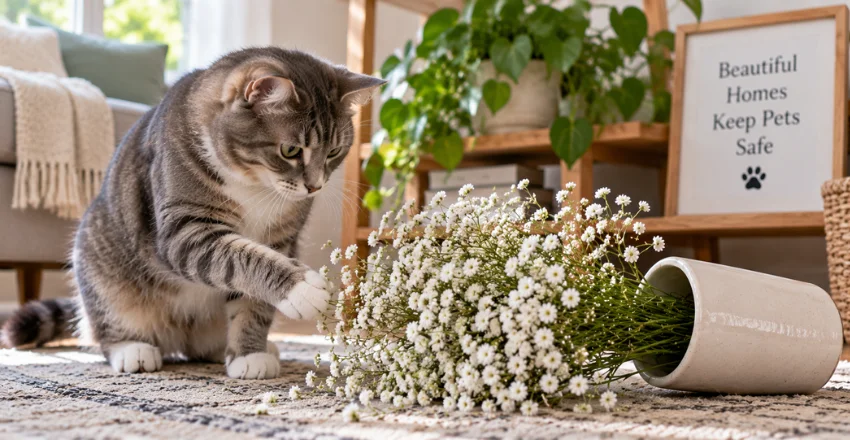
The simplest approach is to prevent access rather than rely on a cat to ignore a vase. Place arrangements in a room your cat cannot access, especially if your pet likes climbing on counters or chewing on leaves. You can also browse the WriteOrTell Pets section as the site expands its pet-care coverage.
Check the scientific names of unfamiliar flowers before bringing a bouquet indoors. Common names can refer to different plants, and the word “lily” is a good example because plants carrying that name do not all have the same toxicity. The FDA and ASPCA recommend taking true Lilium and Hemerocallis species seriously around cats.
If you prefer cut flowers, Pet Poison Helpline lists roses, orchids, sunflowers, snapdragons, and zinnias as safer bouquet choices. Even a non-toxic plant can upset a cat’s stomach if enough plant material is eaten, so keeping floral arrangements out of reach remains sensible. For broader household wellness topics, WriteOrTell also maintains its Health section and Lifestyle section.
The Bottom Line for Cat Owners
For ordinary exposure to Gypsophila, the main concern is mild digestive upset rather than the severe organ damage associated with highly toxic plants. Conflicting labels from respected sources make the terminology seem more alarming than the practical advice: keep the flower out of reach of chewing, monitor an exposed cat, and verify every plant in a mixed arrangement. That approach gives you useful caution without treating every nibble as equivalent to a dangerous exposure to a lily.
If your cat has eaten an unknown flower or is becoming ill, contact your veterinarian instead of relying on an online plant list alone. In the United States, ASPCA Poison Control and Pet Poison Helpline are also available for exposure-specific guidance. Keep a photo, plant label, or bouquet information nearby so the professional helping you has as much identifying information as possible.
Frequently Asked Questions
Is baby’s breath toxic to cats?
ASPCA currently lists Gypsophila elegans as non-toxic to cats, although mild vomiting or diarrhea may occur if eaten. Pet Poison Helpline gives Gypsophila a mild toxicity rating because saponins can irritate the digestive tract. The safest practical approach is to prevent ingestion and watch a cat that has chewed the plant.
What if my cat only sniffed the flowers?
Sniffing plant material without eating it is different from chewing or swallowing it. The larger concern is whether your cat also nibbled a stem, licked plant material from its fur, or contacted another flower in the arrangement. Check mixed bouquets carefully because a dangerous lily can create a far more urgent problem.
Should I call a veterinarian after a small bite?
A veterinarian can give advice based on the amount eaten, your cat’s condition, and whether the plant identification is certain. Seek professional guidance if symptoms appear, continue, or worsen, or if you cannot identify everything in the bouquet. Poison-control services can also help US owners assess a possible exposure.
Is bouillon water safe for cats?
Do not assume that vase water is safe simply because one flower in the bouquet has low toxicity. Water from arrangements containing true lilies can be hazardous to cats, according to the FDA. Keeping cats from drinking bouquet water also prevents exposure to material from other unidentified flowers.