
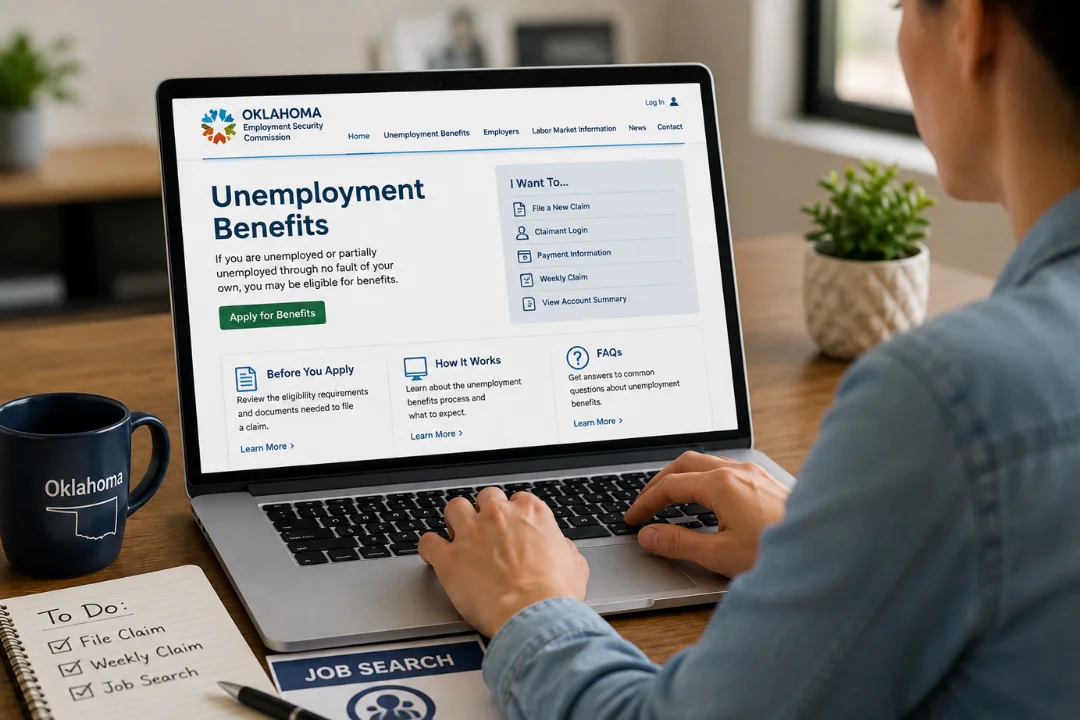
If you searched “unemployment OK,” you’re probably looking for Oklahoma’s unemployment benefits, eligibility rules, payment amounts, or filing process. The Oklahoma Employment Security Commission, or OESC, manages the state program and handles claims through its online claimant portal. Also worth reading: Is Babys Breath Toxic To Cats.
Most Oklahoma workers who lose a covered job through no fault of their own can apply for temporary UI benefits. In 2026, the weekly amount ranges from $16 to $649, with a maximum benefit amount of $10,384. You must file weekly certifications, comply with work-search requirements, and serve one unpaid waiting week.
| Oklahoma UI fact | Unemployment OK: 2026 information |
|---|---|
| State agency | Oklahoma Employment Security Commission |
| Maximum weekly benefit | $649 |
| Minimum weekly benefit | $16 |
| Maximum benefit amount | $10,384 |
| Typical maximum duration | Up to 16 weeks |
| Waiting period | One eligible week without payment |
| Work-search requirement | At least two efforts each claimed week |
| Base period | First four of the previous five completed calendar quarters |
| Federal tax withholding option | 10% |
| Oklahoma tax withholding option | 3% |
What “Unemployment OK” Means in 2026
In this search, “OK” points to Oklahoma. The state’s program provides temporary income to eligible workers after a qualifying job loss. It is funded through employer contributions rather than deductions from workers’ paychecks. If you were looking for the state’s jobless rate instead, Oklahoma’s seasonally adjusted rate was 4.3% in July 2026, according to preliminary Bureau of Labor Statistics data.
The state had about 85,400 people classified as jobless that month. That distinction matters. The jobless rate measures labor market conditions, while UI benefits address an individual worker’s eligibility and claims.
Who Qualifies for Oklahoma Benefits?
OESC lists four main eligibility conditions. You generally need to:
- Lose covered employment through no fault of your own.
- Be able and available to seek and accept suitable work.
- Earn at least $1,500 from a covered employer during your base period.
- Meet Oklahoma’s “1 and 1/2 rule” for base-period wages.
Under that wage rule, your total base-period wages generally must equal at least 1.5 times your highest-quarter wages. For example, $20,000 in the highest quarter would normally require at least $30,000 in total base-period wages. Ordinary UI coverage generally does not apply to self-employment, independent contractor, or gig earnings alone.
A person with qualifying covered wages may have a different situation. Readers interested in the money side of job loss can also browse WriteOrTell’s finance section for related financial topics.
How Much Can You Receive in Oklahoma?
Oklahoma law calculates the weekly benefit amount using 1/23 of your highest quarter of taxable base-period wages. The result cannot fall below $16 or exceed the annual state maximum.
For 2026, OESC lists:
- Maximum weekly benefit: $649
- Maximum benefit amount: $10,384
- Average weekly wage used by the state: $1,130.11
The $10,384 maximum equals 16 payments at the $649 weekly cap. State rules can vary benefit duration, but OESC guidance typically states benefits are available for up to 16 weeks. Here is a simple example. Suppose your highest taxable quarter was $10,000. Dividing $10,000 by 23 produces about $434.78.
Oklahoma rounds benefit calculations under state rules, and OESC makes the official determination. The amount on your monetary determination is the figure that matters for your claim.
How to File an Oklahoma Claim
OESC now uses an online claimant portal for initial applications, identity verification, weekly certifications, and claim management.
Follow these steps:
- Create your claimant account. Provide your name, email, phone number, date of birth, and required verification information.
- Verify your identity. Online applicants generally need an accepted state-issued ID, driver’s license, or resident card.
- Gather your work history. Have employer names, addresses, employment dates, wage details, and separation information ready.
- Submit the initial claim. File through the official OESC claimant portal.
- Register for work. Create a job-seeker account on EmployOklahoma and maintain an active published resume.
- File a certification every eligible week. Weekly certifications are required to receive benefits for that week.
OESC set Oklahoma’s 2026 maximum weekly benefit at $649 and its maximum benefit amount at $10,384, and its official OESC claimant portal is where you start or manage a claim. Workers planning their next career move may also find broader employment-related reading in WriteOrTell’s business section.
Weekly Rules That Can Affect Your Payments
Approval of the initial application does not end your responsibilities. OESC requires most active claimants to complete at least two work-search efforts for every week benefits are claimed. Qualifying activities can include job applications, interviews, approved job-readiness workshops, and certain placement-service registrations.
Keep your work-search records for two years. OESC may request them during an audit. Your documentation should identify the employer, job, date, contact method, and result.
You also need to:
- Submit weekly certifications.
- Report work and gross earnings accurately.
- Reverify your identity every 90 days when required.
- Attend RESEA appointments if OESC selects you for the program.
- Read agency mail and electronic notices promptly.
Missing a required step can delay or stop a payment.
What If You Quit, Were Fired, or Work Part-Time?

Your job separation does not always produce an automatic yes-or-no answer.
| Situation | Can you file? | What OESC may do |
|---|---|---|
| Laid off through no fault of your own | Yes | Review wages and other eligibility rules |
| Quit your job | Yes | Investigate whether you had legally recognized good cause |
| Fired from a job | Yes | Review whether misconduct affects eligibility |
| Working part-time | Potentially | Require you to report hours and gross earnings |
| Receiving severance | Yes | Review whether the payment affects weekly benefits |
OESC says a person who quits or is fired can still file. The agency places an issue on the claim while it determines eligibility. A voluntary resignation without good cause or a discharge for misconduct may result in disqualification. For more general legal reading, see WriteOrTell’s law section.
Waiting Week, Payment Timing, and Taxes
Oklahoma requires one waiting-period week. You must meet the normal eligibility requirements and file that week’s certification, but no payment is issued for it. The waiting week does not reduce your total approved benefit amount. After an eligible certification, OESC says payments are typically issued the following day.
Weekends, holidays, unresolved claim issues, and banking transfers can add time. New claimants may also need to wait for their state-issued debit card. Benefits are taxable income. OESC allows claimants to elect withholding of 10% for federal taxes and 3% for Oklahoma taxes. Recipients receive a Form 1099-G for tax reporting.
What Happens If Your Claim Is Denied?
A denial is not necessarily the final step. OESC allows claimants to appeal determinations. Your appeal should identify the determination being challenged and explain why you disagree. Follow the instructions and deadline printed on the determination you receive. If you remain out of work during an appeal, continue filing your weekly certifications.
Collect relevant records early. These may include termination notices, schedules, emails, pay records, workplace policies, or other documents related to the dispute.
Your Next Step
If you recently lost a covered Oklahoma job, gather your identification, employer information, dates of employment, and wage details. Then use the official OESC claimant portal to file. Keep filing weekly certifications while your claim is active, complete your required job searches, and respond quickly to agency notices. Those routine steps can prevent avoidable delays while you look for your next job.
Frequently Asked Questions
It usually refers to Oklahoma UI benefits or information about unemployment in Oklahoma. For benefit claims, OESC is the state agency responsible for eligibility decisions, weekly certifications, payments, and appeals.
The maximum weekly benefit is $649 in 2026. Your personal amount depends on your taxable wages during your base period and is generally calculated based on your highest-paid quarter.
The 2026 maximum benefit amount is $10,384. At the maximum weekly rate of $649, that represents 16 weeks of benefits. Your monetary determination will show the amount available on your individual claim.
Most claimants must complete and document at least two qualifying work-search efforts each week. Certain temporary layoffs, approved training situations, and qualifying union arrangements may be exempt.
OESC first reviews monetary eligibility and then other eligibility issues. The agency says the U.S. Department of Labor standard requires an eligibility determination within 21 days of a claim becoming monetarily eligible. Individual cases can take longer when wage or separation issues require investigation.