
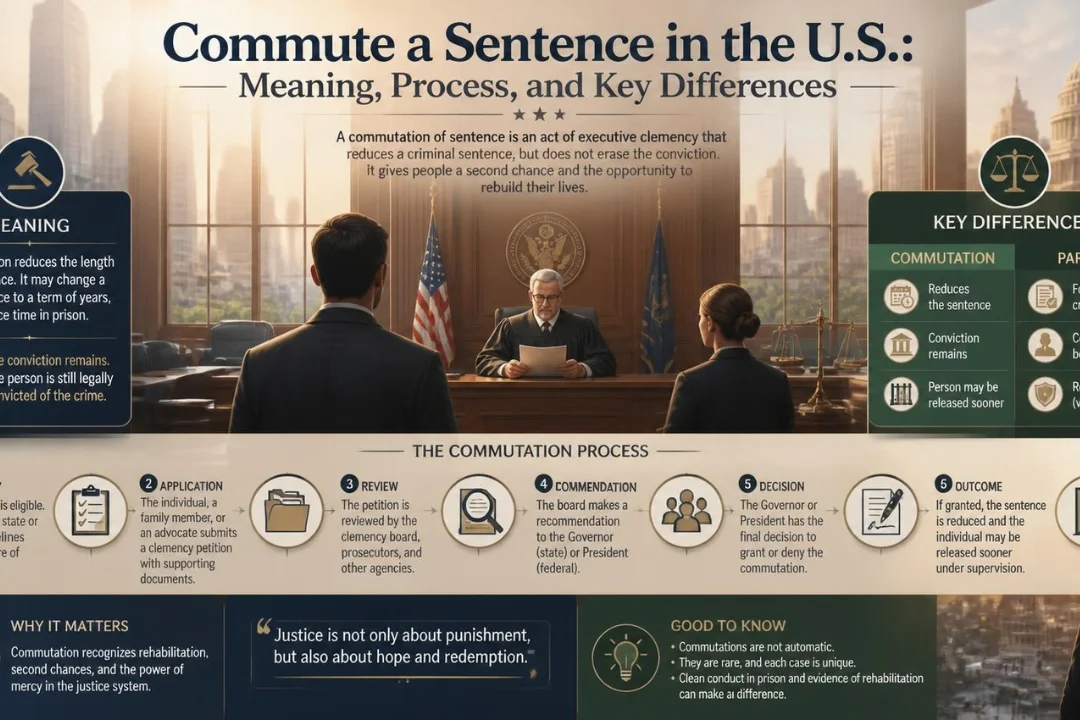
To commute a sentence means to reduce a criminal punishment without erasing the underlying conviction. The punishment may become shorter, lighter, or otherwise less severe. In the United States, commutation is one form of executive clemency.
Commuting a sentence means reducing an existing criminal punishment without erasing the conviction. In federal cases, the U.S. President can grant commutation through the constitutional clemency power. State rules differ, and a governor or clemency board may hold that authority. A commutation can shorten prison time or reduce other penalties.
Quick Facts About Sentence Commutation
| Question | Short answer |
| What changes? | The punishment can be reduced or replaced with a less severe penalty. |
| Does the conviction disappear? | No. The conviction generally remains in place. |
| Who handles federal cases? | The U.S. President has federal clemency power. |
| Who handles state cases? | Authority depends on state law and may involve a governor or clemency board. |
| Is this the same as a pardon? | No. A pardon and a commutation have different legal effects. |
| Does it always mean immediate release? | No. The new punishment may still require more time in custody. |
Key Takeaways
- A commutation changes punishment, not the historical fact of conviction.
- The President’s federal clemency power applies to federal offenses, not ordinary state convictions.
- State clemency rules vary, so the decision-maker depends on the state involved.
- A commutation is different from a pardon, parole, appeal, or expungement.
- Federal applicants can use the Justice Department’s clemency process without hiring a lawyer.
What Does It Mean to Commute a Sentence?
In legal terms, commute a Sentence replaces an imposed punishment with a less severe one. Cornell’s Legal Information Institute describes it as substituting a lesser sentence for one already imposed. That definition focuses on the penalty, not the conviction itself.
Consider someone serving a 20-year prison term that is reduced to 12 years. The conviction still exists, but the remaining punishment becomes shorter. A clemency order may also reduce other criminal penalties, depending on its terms.
Who Has the Power to Grant a Commutation?
For federal offenses, Article II gives the President broad clemency authority. Congress’s Constitution Annotated explains that this power includes commutation of criminal sentences. The power applies to federal offenses rather than ordinary state-law convictions.
State systems work differently because each state has its own constitutional and statutory rules. A governor often has an important role, but some states use boards or shared procedures. Anyone dealing with a state case should check that state’s current clemency rules.
What Can a Commutation Change?
A commutation can reduce the punishment still to be served. Federal guidance says the President may reduce a sentence or change it to time served. The precise effect depends on the language of the clemency grant.
A reduced sentence does not always mean immediate release from custody. Someone may still have months or years left under the new terms. Conditions may also apply when the clemency grant specifically includes them.
Commutation vs. Pardon, Parole, Appeal, and Expungement
These terms can sound similar because each may affect a criminal case after conviction. They operate through different legal mechanisms and can produce different results. Knowing those differences prevents unrealistic expectations about what relief can accomplish.
| Type of relief | Main purpose | Does it erase the conviction? | Who usually decides? |
| Commutation | Reduces an existing punishment | No | President, governor, or other state clemency authority |
| Pardon | Grants executive forgiveness and may remove certain legal disabilities | No automatic expungement | President or state clemency authority |
| Parole | Allows eligible release under supervision where parole exists | No | Parole authority under applicable law |
| Appeal | Asks a court to review claimed legal errors | Potentially, if relief changes the judgment | Appellate court |
| Expungement | Seeks record clearing under applicable law | May clear or seal records, depending on jurisdiction | Court or another authority under applicable law |
A federal pardon does not automatically erase a conviction record. The Justice Department states that the conviction and pardon can both remain on the record. A commutation is narrower because it focuses on reducing punishment.
Does Commutation Mean the Person Is Innocent?
No. Federal guidance says commutation does not imply innocence or change the fact of conviction. Instead, it changes the punishment that follows the conviction.
This distinction matters when reading news reports or discussing a criminal record. A sentence reduction is not the same as a court finding the conviction wrongful. It also does not automatically remove every legal disability tied to the conviction.
Readers learning other courtroom terminology can also see WriteOrTell’s guide to what “sustained” means in court. That guide explains another legal term whose everyday meaning can differ from courtroom use. Understanding those distinctions makes legal news and proceedings easier to follow.
How the Federal Commutation Process Works
A person serving a federal sentence can apply for commutation through the U.S. Department of Justice. The Office of the Pardon Attorney provides a specific application for sentence reduction. The President ultimately decides whether to grant federal clemency.
The Department reviews clemency petitions and may consider circumstances described in federal guidance. Those factors can include sentence severity, illness, age, rehabilitation, or other equitable circumstances. Those factors do not guarantee relief.
Applicants do not have to hire a lawyer to submit a federal clemency application. The Justice Department says the process is designed to be accessible to eligible applicants. People can use the official forms and instructions published by the Office of the Pardon Attorney.
Why a Sentence Might Be Commuted
Executive clemency can address punishment that an executive authority decides should be reduced. Federal guidance identifies sentence disparity, serious illness, old age, and rehabilitation among relevant considerations. The final decision remains discretionary rather than automatic.
A change in punishment can also respond to circumstances that developed after sentencing. Those circumstances may involve health, rehabilitation, or unexpected changes affecting the case. A commutation can provide relief without overturning the conviction itself.
Can a Commutation Be Conditional?
Yes, clemency can include conditions in appropriate cases. Supreme Court precedent recognizes broad federal clemency authority, including conditional forms of relief. The wording of the grant determines what the recipient must follow.
A condition might affect supervision, conduct, or another part of the reduced punishment. The exact possibilities depend on the legal authority involved. Anyone interpreting a specific order should read its terms closely and seek qualified legal advice when needed.
What a Commutation Does Not Do
A commutation does not automatically clear a criminal record. It also does not automatically restore every civil right affected by a conviction. Federal guidance specifically separates sentence reduction from pardon and expungement.
It also does not function like a successful appeal. An appeal asks a court to review legal issues in the conviction or sentence. Clemency instead comes from executive authority and can provide mercy without finding judicial error.
WriteOrTell publishes more plain-language material in its U.S. Law. Readers can use those articles to understand related legal terms before researching a specific jurisdiction. Individual cases may still require advice from a licensed attorney.
A Simple Example
Imagine a person received a 15-year federal prison term that was later reduced to ten years. The person remains convicted of the same federal offense. The executive action changes how much punishment must be served.
If the person has already completed the new term, they may become eligible for release under the order’s terms. If time remains, custody may continue until that reduced term is satisfied. This example shows why “commuted” does not always mean “released immediately.”
Federal and State Cases Are Different
The President cannot use federal clemency authority to change an ordinary state conviction. The Justice Department directs people with state convictions to the appropriate state authorities. Those authorities commonly include governors or state pardon and parole boards.
State procedures can differ considerably, including application requirements and the officials involved. That variation appears in many other areas of American law. WriteOrTell’s guide to legal name-change costs shows how court procedures can differ across states.
What to Do Next
If you are researching a real federal case, start with the official rules: the U.S. Department of Justice states on its clemency application page that it generally does not accept commutation requests until the person has begun serving the sentence, and that petitions go to the Office of the Pardon Attorney. Confirm whether the conviction is federal and review the official commutation application.
General explanations can help you understand the terminology, but they cannot resolve an individual case. Rules, procedures, and legal consequences can depend on jurisdiction and case history. Consider speaking with a licensed attorney when the outcome could affect someone’s rights or release.
Frequently Asked Questions
Does a commuted sentence erase a criminal conviction?
No. The federal Justice Department says commutation does not change the fact of conviction. It reduces all or part of the punishment being served. Record-clearing remedies are separate and depend on applicable law.
Can the President commute a sentence from a state court?
No, presidential clemency power generally applies to federal offenses. State convictions fall under the relevant state’s clemency rules. That authority may involve a governor, board, or another state process.
Is a commutation the same as a pardon?
No. A commutation reduces punishment, while a pardon is a different form of executive clemency. A federal pardon can remove certain legal disabilities but does not automatically expunge the record.
Does a commuted sentence always mean immediate release?
No. The reduced punishment may still leave time to serve. Immediate release occurs only when the new terms make the person eligible to leave custody.
Do you need a lawyer to apply for federal commutation?
No. The Office of the Pardon Attorney says applicants can submit federal clemency petitions without a lawyer. Legal advice may still help when a case involves complicated facts or other legal proceedings.